Natural Fluoride in Utah Tap Water: Does It Remain After HB 81?
Natural fluoride in Utah tap water does not disappear just because a public water system stops adding fluoride. The practical question is what your own supplier’s water contains: natural levels vary by community, and a statewide rule cannot tell you the amount at a particular tap. Here’s what HB 81 changes, what it does not establish, and how to look for local data.
The short answer: natural fluoride and HB 81
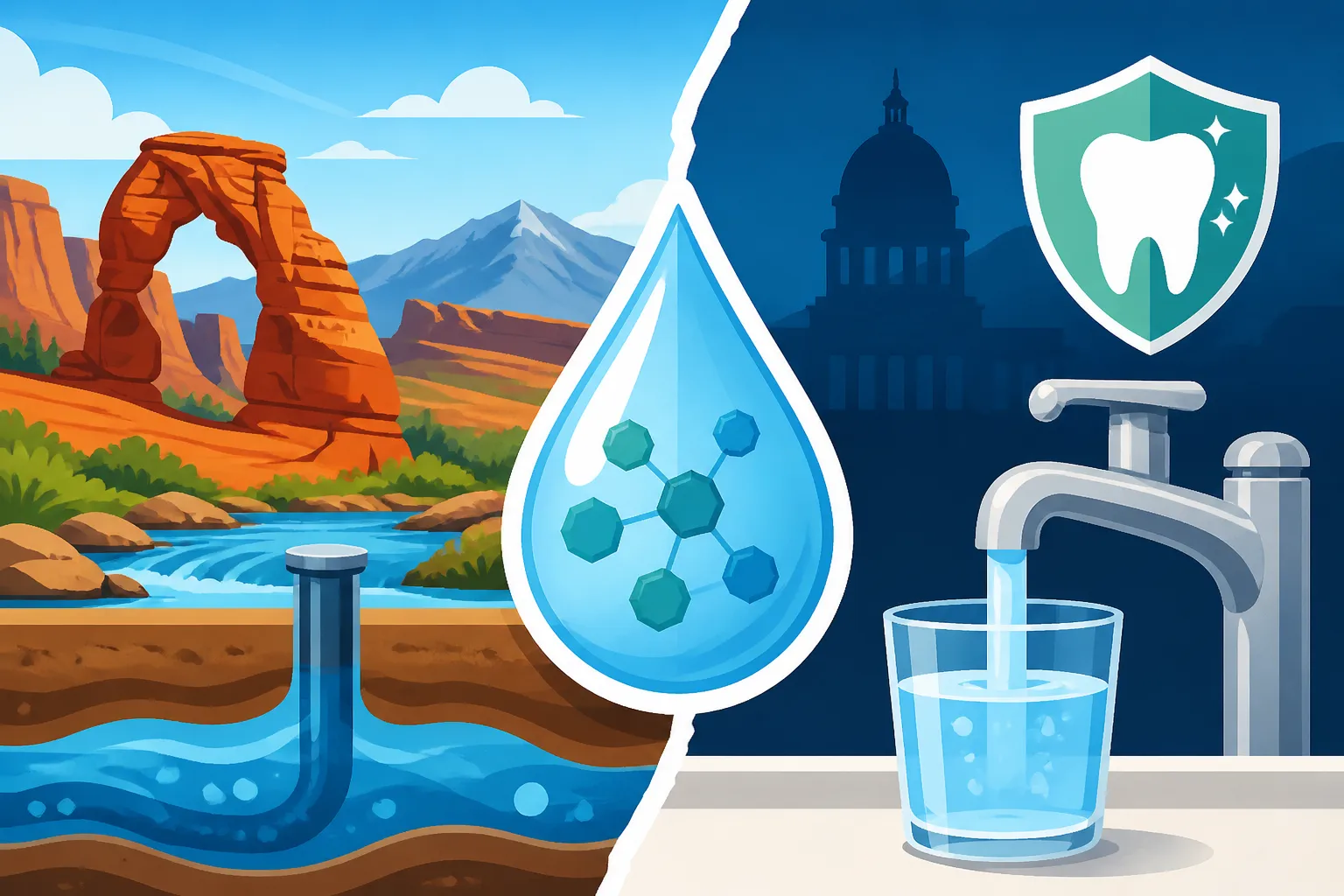
Natural fluoride can remain in Utah tap water after HB 81. The law addresses adding fluoride to public drinking water systems; it does not mean naturally occurring fluoride is removed from the water. But that does not mean every tap has the same level, or that a local level can be inferred from the law alone.
According to the Utah Department of Health and Human Services, the amount of naturally occurring fluoride in water is Different for each community. The department also says Most people in Utah live where natural fluoride in water is insufficient to protect their teeth. Those points make local information important: a statewide rule does not describe the natural fluoride level at every home.
According to Granger-Hunter Improvement District, the addition of fluoride to public drinking water systems will now be prohibited. That statement describes the rule on adding fluoride. It does not say that water systems must remove fluoride that is already present naturally.
| Question | What the available information supports | What it does not tell you |
|---|---|---|
| Does HB 81 prohibit adding fluoride to public drinking water systems? | Granger-Hunter Improvement District says the addition of fluoride to public drinking water systems will now be prohibited. | The rule alone does not provide a fluoride result for a particular tap. |
| Does the law mean all natural fluoride is removed? | No. A prohibition on adding fluoride is not the same as a requirement to remove naturally occurring fluoride. | It does not establish whether a particular supplier’s natural level has changed. |
| Is natural fluoride the same across Utah? | No. Utah DHHS says the amount is Different for each community. | A statewide average or another city’s result cannot establish a household’s level. |
| Is natural fluoride enough to protect teeth in every community? | Utah DHHS says Most people in Utah live where natural fluoride in water is insufficient to protect their teeth. | That statewide statement does not determine an individual’s dental needs. |
The most useful takeaway is to separate three questions: whether a supplier adds fluoride, whether fluoride occurs naturally in its source water, and what amount is present in water delivered to your address. The rule answers the first question. A utility report or a direct request to your supplier may help with the others.
For a broader look at differences in taste and water characteristics around the state, see Utah Tap Water Taste, Hardness, and Seasonal Differences. For the rule’s scope, What Utah HB 81 Mandates for Public Drinking Water Fluoride is a useful next read.
What HB 81 changes—and what it does not
It helps to read the rule narrowly. According to Granger-Hunter Improvement District, HB 81 prohibits the addition of fluoride to public drinking water systems. That is a statement about adding fluoride to the public supply. It is not a statement that all fluoride must be absent from tap water.
Fluoride may be present in source water before it reaches a treatment plant. When that is the case, a ban on adding fluoride does not, by itself, tell you that the naturally occurring amount has changed. Nor does it tell you how much fluoride was present before the rule, what a supplier’s current level is, or how that level might vary over time. Those are questions about the specific water source and supply, not about the general meaning of the prohibition.
A useful way to keep the terms straight is:
- Added fluoride refers to fluoride a public water system deliberately adds to its supply.
- Natural fluoride refers to fluoride already present in water from its source.
- Measured fluoride refers to a result from testing a water sample. The result applies to the sample and its collection context, not automatically to every community or home.
The distinction matters because “no longer adding fluoride” and “no fluoride in the water” are not interchangeable claims. A supplier could stop adding fluoride while natural fluoride remains in its source water. Conversely, a community may have a low natural level even though it once received added fluoride. To understand a local change, look for actual local data rather than treating the legal rule as a water test.
The law also does not establish that every public water supplier has the same source, treatment approach, or natural fluoride level. A community’s supply may be tied to local source water and operational choices. If a supplier uses more than one source or changes how it supplies an area, an old result may not answer what is in the water now. Ask the supplier whether a reported number refers to source water, finished water, or a particular sampling period.
It is also important not to assume that one kind of water report will answer every question. A consumer water quality report may contain useful information, but its presentation and level of detail can vary. If you do not see fluoride results, ask the supplier directly whether it has natural-fluoride data and what the result represents. Guide to Utah Consumer Confidence Reports and Tap Testing explains how to approach local reports and testing.
If you are trying to understand what a city or town may do under the rule, see Can Utah Municipalities Choose to Add Fluoride to Tap Water?. That is a separate question from whether naturally occurring fluoride remains in the water a system delivers.
How to find natural fluoride in your tap water
Start by identifying who supplies the culinary water to your address. In some places, the provider may be a city or town; elsewhere, a separate water district or another supplier may serve the property. The supplier’s name matters because natural fluoride varies by community, and a result from a nearby area may not apply to your home. If you are unsure who serves your address, How to Find Who Supplies Culinary Water to Your Address can help you narrow it down.
Once you know the provider, look for a recent water quality report or contact the supplier through its official website. Search the report for fluoride and check whether it gives a measured result. If a result appears, note the units, the sampling period, and whether the result refers to finished water delivered to customers or to a source. Do not assume that a figure from an older report reflects the current supply.
If fluoride is not listed, that does not by itself establish that the water contains none. It may mean the report does not provide the detail you need. Ask the supplier a focused question, such as whether it has measured naturally occurring fluoride in the water delivered to your service area and whether it can explain what the result represents. For a more detailed approach, see Requesting Natural Fluoride Data From Your Culinary Provider.
When reviewing an answer, consider these practical questions:
- Does the information refer to your supplier, rather than a neighboring city or a statewide summary?
- Is the sample from source water or treated water delivered to customers?
- Is the result recent enough to answer your current question?
- Does the provider explain whether it uses different sources or blends water?
- Are the units and sampling details clear?
If you cannot get a useful result from the supplier, a water test may be an option. Choose the test based on the question you want answered, and ask the laboratory what sample collection and handling it requires. A result from a single household tap can help describe that sample, but it may not represent every property on the same system. For homes using a private well, public-system reports are not a substitute for testing the well water. See Natural Mineral Trace Levels After Ending Additive Programs for context on why measured natural levels and changes to additive programs are distinct topics.
A home test kit may not provide the same detail as a laboratory result. If the number will guide a household decision, check what the test measures, how its result is reported, and whether the method is suitable for your purpose. Avoid comparing results that use different units or come from different kinds of samples without first confirming that the comparison is meaningful.
The key is to seek a result tied to the water you actually use. A general statement about Utah, a result from another town, or the fact that a system is no longer adding fluoride cannot establish the natural fluoride level at your tap.
What a local fluoride result can—and cannot—tell you
A local measurement can help answer a narrow question: how much fluoride was found in the particular sample, according to the method and sampling details provided. It does not automatically reveal what every home in the system receives, whether the level is stable across all sources, or what a particular person needs for dental care.
Pay attention to the context around the result. A source-water result and a finished-water result describe different points in the supply process. A result from a particular sampling period may not reflect later changes in sourcing or system operations. If the provider gives a range or multiple results, ask what explains the difference and which information is most relevant to your address.
Do not treat a reported natural level as a personal health recommendation. Utah DHHS’s statement that Most people in Utah live where natural fluoride in water is insufficient to protect their teeth is a broad statement about Utah residents, not an individualized assessment. It does not tell you what dental care, products, or supplements any particular person should use.
If you are concerned about dental health, ask a dentist or other medical professional for guidance that considers your circumstances. For questions about local water information, contact the supplier or your local health department. A water result can inform those conversations, but it cannot replace professional advice about an individual’s health.
If you are considering a filter or treatment device because of fluoride, begin with a verified result and the exact reduction claim for the device. A product’s general label or broad description is not enough to establish that it is certified or designed to reduce fluoride. Check the certification and performance claim against your own test results, and follow the product’s maintenance instructions. A filter should not be assumed to remove fluoride merely because it improves taste or reduces another substance.
It is also possible for a person to ask about fluoride for more than one reason. A household may be trying to understand what naturally remains in its drinking water, while also asking a dental professional about prevention. Keep those questions separate: the supplier can clarify water data, while a dental professional can advise on dental care. For health questions about fluoride, see Fluoride in Utah Tap Water: What Are the Real Dental Health Risks? and discuss personal concerns with a qualified professional.
Frequently Asked Questions
Does HB 81 remove naturally occurring fluoride from Utah tap water?
The rule described by Granger-Hunter Improvement District prohibits adding fluoride to public drinking water systems. It does not say that naturally occurring fluoride must be removed.
Does every Utah community have the same natural fluoride level?
No. Utah DHHS says the amount of naturally occurring fluoride in water is Different for each community. Check with the supplier serving your address for local information.
If a supplier no longer adds fluoride, can its tap water still contain fluoride?
Yes. A prohibition on adding fluoride does not establish that naturally occurring fluoride is absent. A local result is needed to understand what is in a particular supply.
What should I do if I cannot find a fluoride result in my water report?
Ask your supplier whether it has natural-fluoride data for the water delivered to your area and what the result represents. If you still need a measurement, ask a laboratory about appropriate testing and sample collection.
Should I make a dental decision based on a water report?
A water report describes water data; it does not provide individualized dental advice. Ask a dentist or medical professional about personal dental concerns.
Sources
- Utah Department of Health and Human Services — Fluoride in Utah | PCRH (checked November 14, 2026)
- Granger-Hunter Improvement District — Water Quality – Granger-Hunter Improvement District (checked November 14, 2026)
Disclaimer
This article is for general informational purposes only and does not constitute professional advice. Laws, prices and regulations vary by location and change over time. Consult a qualified professional for guidance on your specific situation. Utah Water Central is not a government agency or water utility and is not affiliated with any public water system.