Mineral Crust on Utah Fixtures: Softener or Carbon Filter?
Mineral crust on a faucet, showerhead, kettle, or glass can make Utah tap water seem like a filtration problem. But the right fix depends on what the deposit is and what you want to change: hardness, taste, odor, or something else. Here’s how to tell whether a softener or carbon filter fits—and when neither is the answer.
What mineral crust can tell you about your water
A pale, chalky film that returns after you clean a fixture is often consistent with mineral scale. Hard water contains dissolved minerals, especially calcium and magnesium. When droplets evaporate, some of those minerals can remain as a deposit on a faucet, shower screen, kettle, or dish.
The appearance alone cannot confirm the deposit’s composition. White residue may have other causes, and a crust on a fixture does not tell you whether the water has a particular health risk. It is a clue about what may be happening at that surface, not a water test.
Scale is more likely when it forms repeatedly where water sits or evaporates, such as around the faucet aerator, on a showerhead, or inside an appliance that heats water. A film that wipes away easily may be ordinary residue. A hard buildup that returns in the same places is a stronger reason to check water hardness.
Water hardness and water quality are related only in limited ways. A hardness result describes the amount of hardness minerals; it does not provide a full inventory of contaminants. Likewise, a public water quality report may help you understand regulated water-quality results, but it may not answer how hard the water is at your particular tap. The report and a hardness test serve different purposes. For help distinguishing them, see Utah Tap Water Taste, Hardness, and Seasonal Differences and Reading Your Utah Water Quality Report: MCLs, Units, and Tables.
The pattern of the deposits can offer useful clues:
- Scale at several taps: If mineral crust appears on fixtures throughout the home, hardness in the incoming water is one possibility.
- A problem at just one tap: A clogged aerator, local plumbing issue, or fixture-specific buildup may be involved. Check the fixture before assuming a whole-house treatment system is needed.
- Residue only on certain surfaces: Water that dries on glass or dishes can leave visible spots even when the fixtures themselves do not have a persistent buildup problem.
- A change that began suddenly: A new odor, color, or flow issue is not automatically a hardness problem. Check for utility notices and consider whether plumbing work or a change in household equipment could explain it.
Location can matter, but it is not a substitute for measurement. Utah homes may receive water from different sources, and a water source or blend can affect what someone notices at home. Do not assume a neighbor’s results apply to your address. If you want to compare local hardness patterns, How to Check Your Utah Water Hardness Number for Softener Setup explains what to look for and how to use a hardness result.
Scale can be frustrating and may interfere with cleaning or appliance performance, but treating it is a practical choice rather than a response to a health diagnosis. If you are concerned about a health effect, ask your local health department or a medical professional. If you are uncertain about a water-quality issue, start with the water supplier’s current information and testing appropriate to the question.
Softener or carbon filter: what each one is designed to do
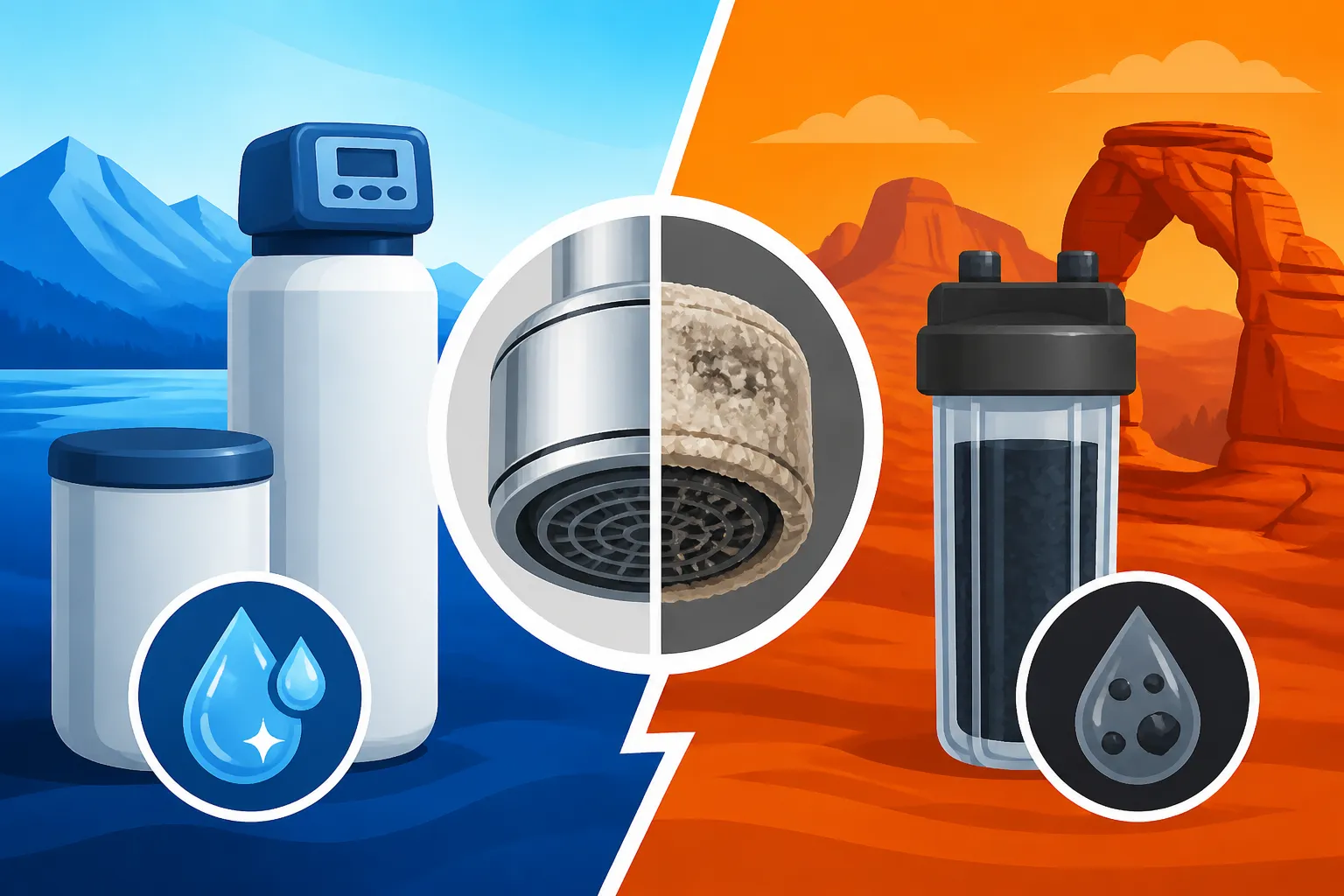
A water softener and a carbon filter are not interchangeable. They address different water concerns, so choosing between them starts with identifying the problem you want to solve.
| Treatment | Main purpose | What it may change | What it is not a substitute for |
|---|---|---|---|
| Water softener | Reduce hardness minerals through ion exchange | Hardness-related scale and some effects of hard water | A complete drinking-water filter or a treatment selected for every contaminant |
| Activated carbon filter | Adsorb certain substances, depending on the media and verified product claims | Some taste or odor concerns and other substances specified for the particular filter | A hardness treatment or a general-purpose answer to every water issue |
| No new treatment | Avoid equipment when the cause is local or the result is acceptable | May be the right choice if cleaning or fixture maintenance solves the issue | Testing when you need a reliable answer about water composition |
A conventional ion-exchange softener reduces hardness by exchanging calcium and magnesium ions for other ions, commonly sodium or potassium. That can reduce the mineral deposits associated with hard water. It does not mean the system removes every dissolved substance, and it should not be treated as a general purifier.
A carbon filter works differently. Activated carbon can adsorb some substances, but what a particular unit is designed to reduce depends on its media, construction, use conditions, and certification claims. A carbon filter that is useful for a particular taste or odor concern does not become a softener just because it is installed on the same household plumbing. Most standard carbon filters are not designed to remove hardness minerals.
That difference matters when the visible problem is crust. If a test confirms hardness and your goal is to reduce scale throughout the home, a softener is generally the type of treatment to investigate. If hardness is not the concern and your goal is to address a specific taste or odor, a suitably certified carbon filter may be more relevant. If you want both outcomes, you may need separate equipment, but only after confirming that each device matches a measured need.
A softener also changes the mineral balance of the treated water rather than simply trapping scale in a cartridge. The specific outcome depends on the equipment and settings. Before installing one, consider where softened water will go, how the household uses water, and whether the equipment’s operating and maintenance requirements fit the home. A softener may not be necessary just because a few spots appear on glass.
For carbon, check the exact model rather than relying on broad claims such as “improves water” or “removes contaminants.” Look for certification or performance information that names the substances the model is designed to reduce, then compare that information with your actual concern or water test. A product’s claims for one substance do not establish performance for another. Utah Home Water Filtration: Choosing Filters for Tap or Well and How to Match a Utah Filtration System to NSF Standards can help you think through that comparison.
The Utah Department of Environmental Quality states: There are currently no State rules regarding the safety or effectiveness of home water treatment devices. That makes it especially important to check the device’s certification, intended use, maintenance requirements, and performance documentation yourself, rather than treating a general marketing statement as proof that a product fits your water.
How to decide what your home needs
Start by separating the visible symptom from the treatment decision. It is easy to see a crust and jump directly to buying equipment, but a short diagnostic process can help avoid paying for a system that does not address the cause.
Check the deposit and the fixture
Look at where the buildup appears and whether it is widespread. If it is concentrated on one faucet, remove and inspect the aerator if you can do so safely. Debris or a partially blocked screen may explain poor flow without requiring a whole-house treatment system. If buildup is appearing at multiple fixtures and appliances, a water hardness test can help clarify whether hardness is a likely contributor.
A deposit’s color is not a reliable substitute for a test. If the water is discolored, has a persistent unusual odor, or changes suddenly, do not assume that a softener or carbon filter will resolve it. Check current notices from your supplier if you receive municipal water. For a sudden flow or water-quality concern, Brown Tap Water After a Pressure Drop: When to Flush and When to Wait may help you distinguish a temporary service issue from a household treatment question.
Test for the question you actually have
If the question is “Is my water hard?”, choose a test that measures hardness. A test strip may be useful for an initial indication, but a result near a decision point or an inconsistent reading may justify a more reliable test. If the question is about a specific contaminant, a hardness test cannot answer it. Select a laboratory test or product certification that corresponds to that separate concern.
If you are on municipal water, ask the supplier what information is available for the water it provides. A utility report covers the system’s reported results, but conditions at a home’s tap can also be affected by plumbing and the time water has been sitting in pipes. If you are on a private well, the responsibility for understanding the water falls to the well owner; do not assume a nearby public system’s information describes a private supply.
Testing can also prevent mismatched treatment. For example, a carbon filter selected for taste may leave hardness-related scale unchanged. A softener selected for scale may not address a different concern that requires a specific filter. The useful question is not simply whether a device can change water, but whether it is designed and verified to change the thing you measured.
Match the treatment to the goal
Use your result and priorities to decide whether treatment is worthwhile:
- If hardness is confirmed and recurring scale is the main frustration, look into a softener and compare its capacity, controls, upkeep, and installation needs with your household’s situation.
- If the water’s taste or odor is the main concern, identify what may be causing it before choosing a carbon filter. Confirm the exact filter’s claims against the issue you are trying to address.
- If scale is limited to one fixture, troubleshoot or clean that fixture before considering whole-house equipment.
- If you have concerns about a contaminant, use a test designed for that contaminant and select treatment with a verified claim for it. A hardness result alone is not enough.
- If the crust is manageable and the water otherwise meets your needs, regular cleaning may be more sensible than adding equipment.
If you are renting, check your lease and ask the property manager before modifying plumbing or installing equipment. If your home is part of an association, check its rules too. For renters who want non-permanent options, Utah Renter Hard Water Guide: Fixes Without a Softener covers approaches that do not require installing a whole-house softener.
What to compare before buying equipment
Once you know the goal, compare products by their documented performance and practical demands, not by the number of stages, the label on the box, or a broad promise. A treatment system is only useful when it is suitable for the water, installed correctly, maintained on schedule, and used within its stated limits.
For a softener, check whether its design is suitable for the household’s measured hardness and expected water use. Consider how it regenerates, how its settings are chosen, what supplies or upkeep it needs, and where the unit can be installed. Review what water it treats and whether a bypass is part of the setup. A unit that is too small, poorly configured, or neglected may not perform as intended. Utah Water Softener Guide: Regeneration, Salt Types, and Scale provides more detail on the operating choices that affect softener use.
For a carbon filter, look for the exact contaminant or aesthetic issue named in the performance documentation. Check the applicable certification, the conditions under which the claim applies, the capacity, and the cartridge replacement instructions. A filter’s performance can change as media is used, so installation is not the end of the maintenance plan. If you are considering Clearly Filtered, check the documentation for the specific product and confirm that its stated reduction claims match your test results and intended use. Do not assume that every product from a brand is designed for the same purpose.
Also consider where the equipment is installed. A point-of-use filter serves a particular outlet, while a whole-house system treats water entering the home. Those approaches have different costs and maintenance footprints, so choose based on where the problem occurs and where treatment is actually needed. A whole-house system may be unnecessary if the concern is limited to drinking water at a kitchen tap. Conversely, a small drinking-water filter is not a whole-house scale solution.
Ask an installer or supplier specific questions before committing:
- What water test or result supports this recommendation?
- Which measured problem is this exact model designed to address?
- What certification or performance documentation supports that claim?
- What maintenance does the system require, and how will you know when it is due?
- Will installation affect the home’s plumbing, drainage, or available space?
- What ongoing supplies or service may be needed, and where can you confirm current costs?
- Does the system leave any other water-quality concern untreated?
It is reasonable to compare quotes, but do not let a sales visit substitute for testing or a clear explanation of the device’s performance. If a seller recommends a treatment based only on a quick demonstration or a broad statement about “impurities,” ask for the relevant test result and written documentation for the exact equipment. A system should be selected for a defined purpose, not because it is the most complex option available.
Reducing crust and keeping the system useful
Even if you choose treatment, routine fixture care still matters. Scale already on a faucet or showerhead may not disappear as soon as a softener is installed; existing deposits generally need cleaning or removal. Follow the fixture manufacturer’s cleaning instructions and avoid harsh methods that could damage a finish. For detachable parts, a careful inspection can also reveal whether debris or mineral buildup is restricting flow.
If you install a softener, use the hardness result and the equipment instructions to set it appropriately. Do not copy a neighbor’s setting or assume that a setting advertised for another water supply fits your home. Recheck performance when you have reason to suspect a change, such as a persistent return of scale or a change in the household’s water supply. For help understanding setup, see How to Find Your Utah Water Hardness Number for Softener Setup.
A softener requires ongoing attention. Follow the manufacturer’s maintenance schedule, check that the system is operating as intended, and investigate if hardness appears to break through or the unit stops using its supplies normally. A salt-based softener also has a regeneration process, so installation and operation should account for the system’s discharge and the home’s plumbing. If your home uses a septic system, confirm that the proposed discharge is compatible with the system and local requirements before installation.
Carbon filters also need maintenance. Replace cartridges according to the manufacturer’s instructions and the stated capacity or service conditions. A filter that has passed its rated service life should not be assumed to continue performing as advertised. If taste or odor changes after installation, check the cartridge, installation, and product instructions before concluding that the filter is addressing the wrong issue.
Keep the original test results, product documentation, and maintenance records together. They make it easier to check whether a system is still being used for the purpose it was selected for and to explain the setup to a future owner or service technician. If results change, retest the specific issue rather than buying another device based on appearance alone.
The simplest decision is often the most useful: a hardness result and repeated scale support looking into a softener; a specific taste or odor concern may call for a verified carbon filter; and a single troublesome fixture may need cleaning or repair instead. No treatment device should be expected to solve a problem it was not designed and verified to address.
Frequently Asked Questions
Does a carbon filter remove mineral crust?
A standard carbon filter is generally not designed to remove hardness minerals that cause scale. Check the exact product’s documented claims, but do not choose carbon as a substitute for a softener when hardness is the confirmed issue.
Will a water softener remove every mineral or contaminant?
No. A conventional softener targets hardness through ion exchange. It is not a universal treatment system, and a separate test may be needed to identify other water-quality concerns.
Can I tell how hard my water is by looking at a faucet?
Visible scale can suggest a hardness issue, but it does not measure hardness or identify every possible cause of a deposit. Use a suitable hardness test if you need a reliable result.
Should I install both a softener and a carbon filter?
Only if you have separate, measured needs that each system is designed to address. Confirm the specific performance claims and maintenance requirements before choosing either device.
Sources
- Utah Department of Environmental Quality — Drinking Water Frequently Asked Questions (Utah DDW) – Utah Department of Environmental Quality (checked November 14, 2026)
Disclaimer
This article is for general informational purposes only and does not constitute professional advice. Laws, prices and regulations vary by location and change over time. Consult a qualified professional for guidance on your specific situation. Utah Water Central is not a government agency or water utility and is not affiliated with any public water system.